 LANGUAGE
  English
 русский
 Español

Content
Regarding whether die casting or CNC machining is cheaper, the answer actually depends on how many parts you plan to produce.
It's like printing flyers: if you only need one, handwriting is the cheapest; if you need ten thousand, using a printing press is the most cost-effective.
Here's a detailed comparison of their costs:
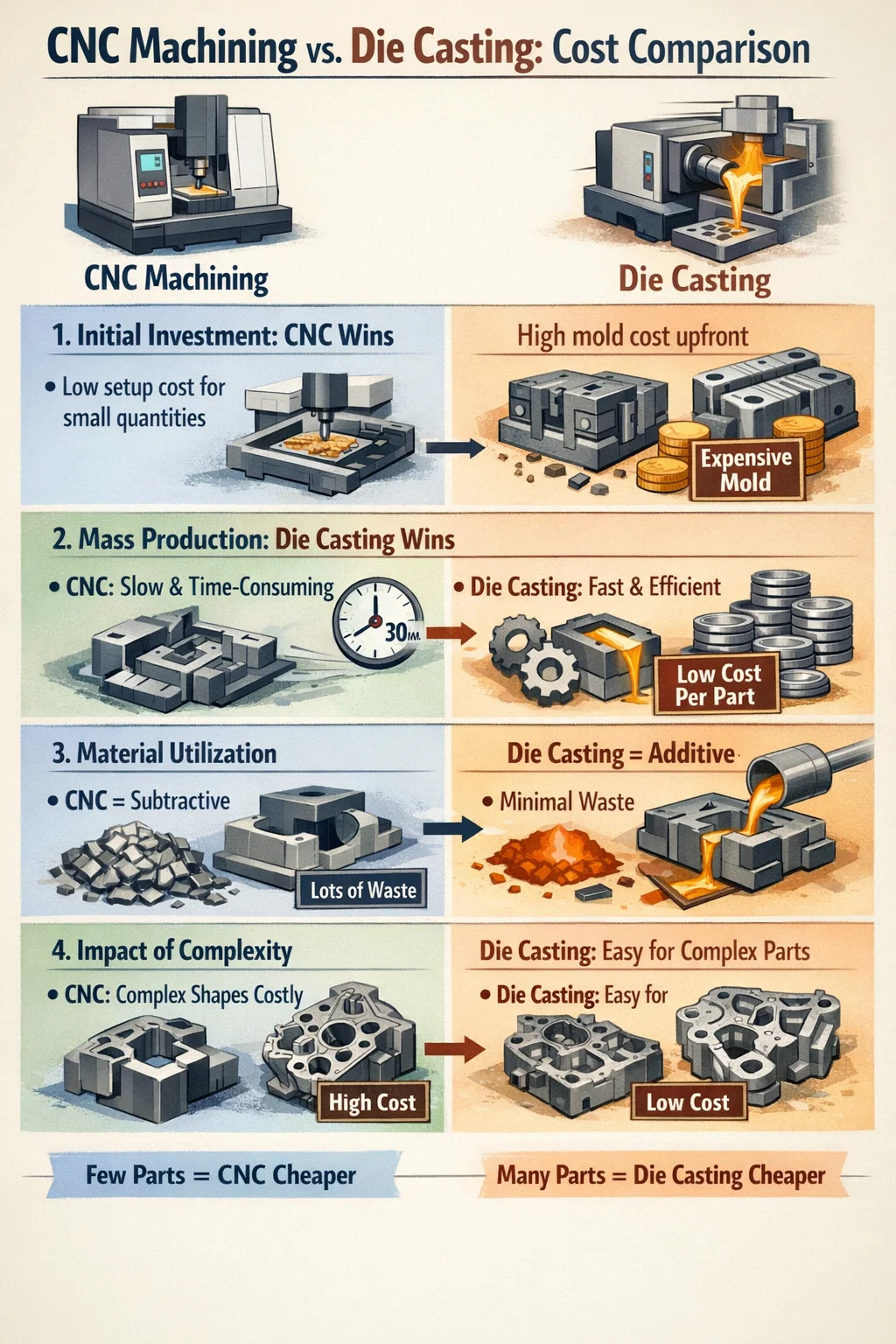
1. Initial Investment: CNC wins
If you only need a few samples or dozens of parts, CNC is much cheaper.
CNC is like "tailor-made": You just send the design drawing to the machine, and it starts cutting from a solid block of metal. Besides buying materials and paying for electricity and labor, there are basically no other significant costs.
Die casting is like "building a house": Before you can produce the first part, you have to invest heavily in a steel mold. This expense is very large, and if you only make a few parts, the unit cost will be prohibitively expensive.
2. Mass Production: Die casting wins
Once your part quantity reaches thousands or even tens of thousands, the advantages of die casting become apparent.
Speed determines cost: Die casting can "produce" a part in seconds, while CNC might take half an hour of meticulous work. Time is money, and in large-scale production, the efficiency of die casting can drive the unit cost down to a very low level.
Economies of scale: Once that expensive mold is made, the more parts produced, the less the mold cost is spread across each part, eventually becoming negligible.
3. Material Utilization
CNC is "subtractive": It cuts away the unnecessary parts from a large block of metal. If you need to make a hollow shell, a large portion of the expensive metal ends up as scraps (although it can be recycled, its value is significantly reduced).
Die casting is "additive": It injects only the required amount of molten metal, resulting in almost no waste. This precise use of materials saves a significant amount of money in large-scale production.
4. Impact of Complexity
If the part has a very unusual shape with many complex curves or hollows, CNC machining will be very difficult. Tool changes and complex tool paths will significantly increase processing costs. In the case of die casting, as long as the mold is properly designed, the metal liquid will solidify into the desired shape the moment it's poured in, regardless of how complex the shape is. The more complex the shape, the more significant the cost savings of die casting compared to CNC machining.
| Feature | CNC Machining | Die Casting |
| Small Batch (e.g., 1-100 units) | Cheaper (No mold/tooling costs) | Very expensive (High initial mold cost) |
| Mass Production (e.g., >2,000 units) | Expensive (Process takes too long) | Cheaper (Extremely low unit price) |
| Material Waste | Higher (Lots of chips from cutting) | Minimal (Injected as needed) |
| Design Change Cost | Low (Just update the code) | Very high (May require a new mold) |