 LANGUAGE
  English
 русский
 Español

Content
- 1 Dimensional Accuracy and Tight Tolerances
- 2 High Production Speed and Cycle Time
- 3 Complex Geometry Capability
- 4 Surface Finish Quality
- 5 Material Efficiency and Recyclability
- 6 Cost Economics at Scale
- 7 Consistency and Repeatability Across Long Production Runs
- 8 Alloy Options and Mechanical Properties
- 9 Applications Where Die Casting Delivers the Most Value
- 10 Limitations to Factor Into Your Process Selection
- 11 Emerging Developments Extending Die Casting Capability
The main advantage of die casting is its ability to produce large volumes of complex, dimensionally accurate metal parts at high speed with minimal post-processing. In a single production cycle, die casting delivers tight tolerances, smooth surface finishes, and consistent repeatability that few other metal forming processes can match. For industries where precision and throughput both matter — automotive, electronics, aerospace, consumer goods — die casting sits at the intersection of efficiency and quality.
This article breaks down exactly why die casting holds its dominant position in modern manufacturing, covering dimensional accuracy, speed, material efficiency, cost economics, and how it compares to competing processes.
Dimensional Accuracy and Tight Tolerances
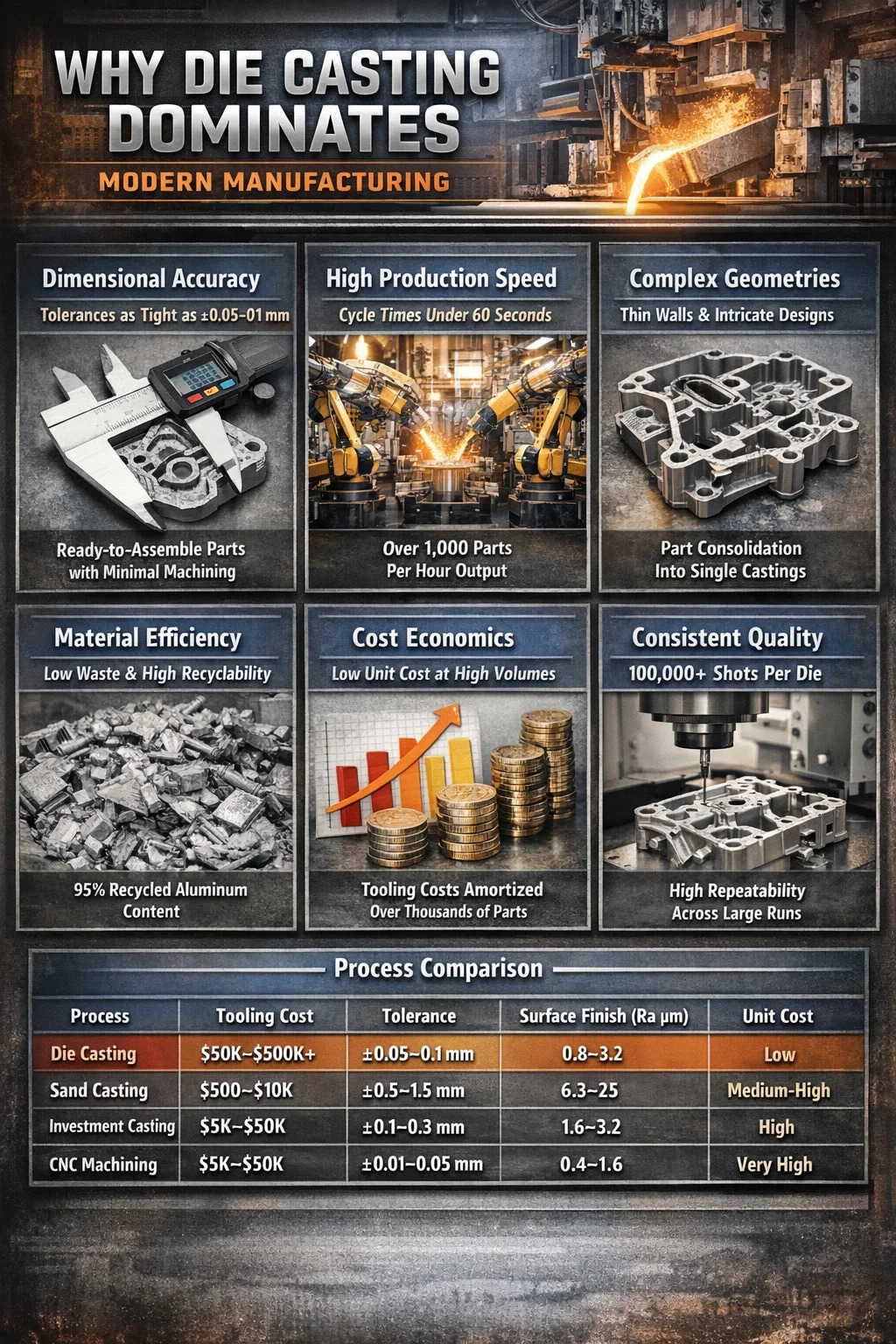
Die casting consistently achieves tolerances as tight as ±0.1 mm on most features, and in precision tooling setups, tolerances of ±0.05 mm are achievable. This level of accuracy is built into the process itself — molten metal is injected under high pressure (ranging from 1,500 to over 25,000 psi depending on alloy and part geometry) into hardened steel dies that maintain their shape across hundreds of thousands of shots.
What this means in practice: parts come out of the die casting process ready to assemble or requiring only minor secondary machining. Holes, threads, bosses, ribs, and undercuts can often be cast directly into the part. Compared to sand casting, which typically holds tolerances of ±0.5 mm or worse, die casting reduces the need for CNC finishing operations significantly.
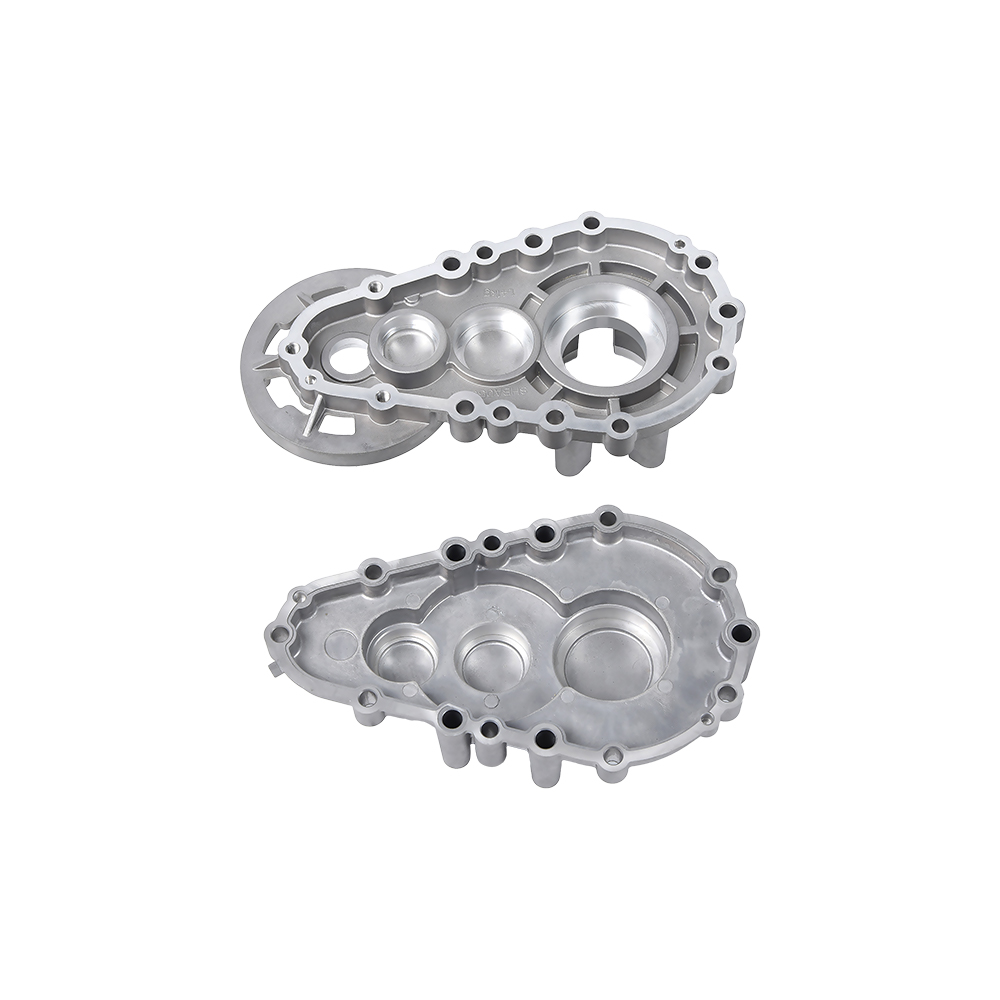
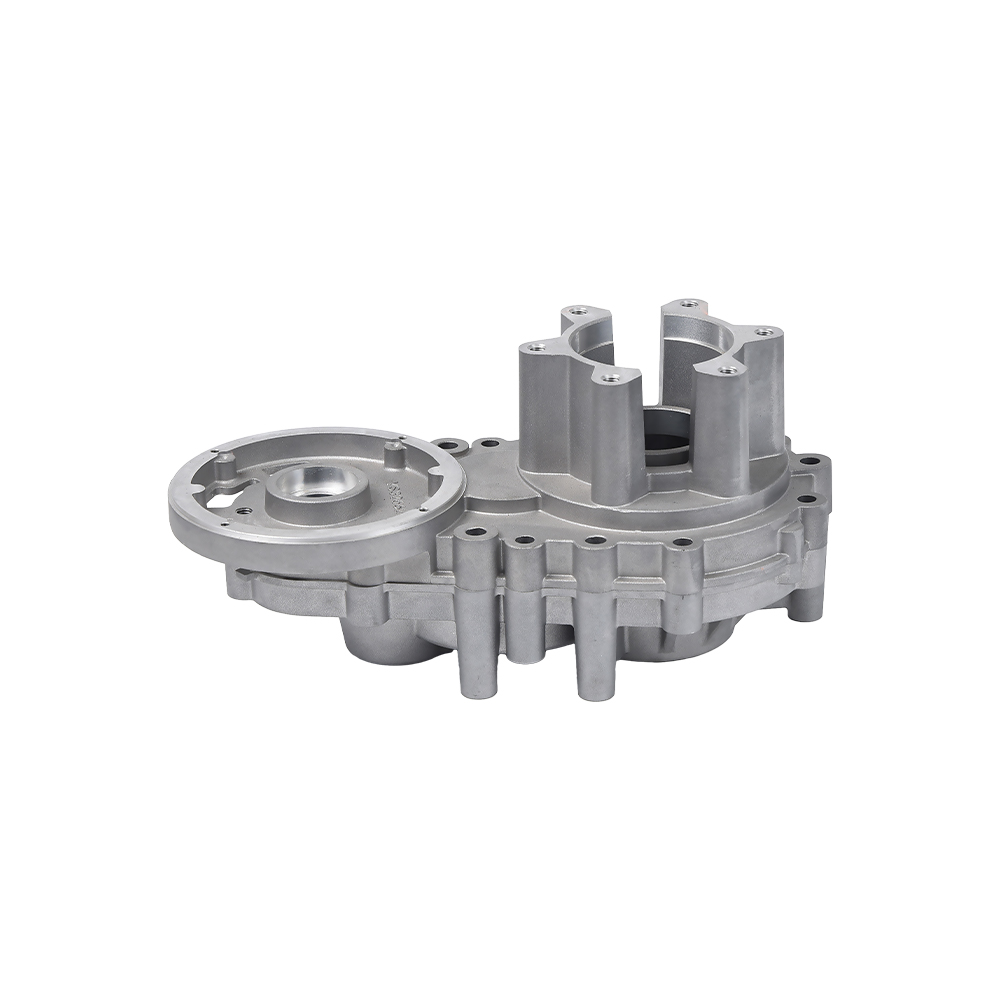
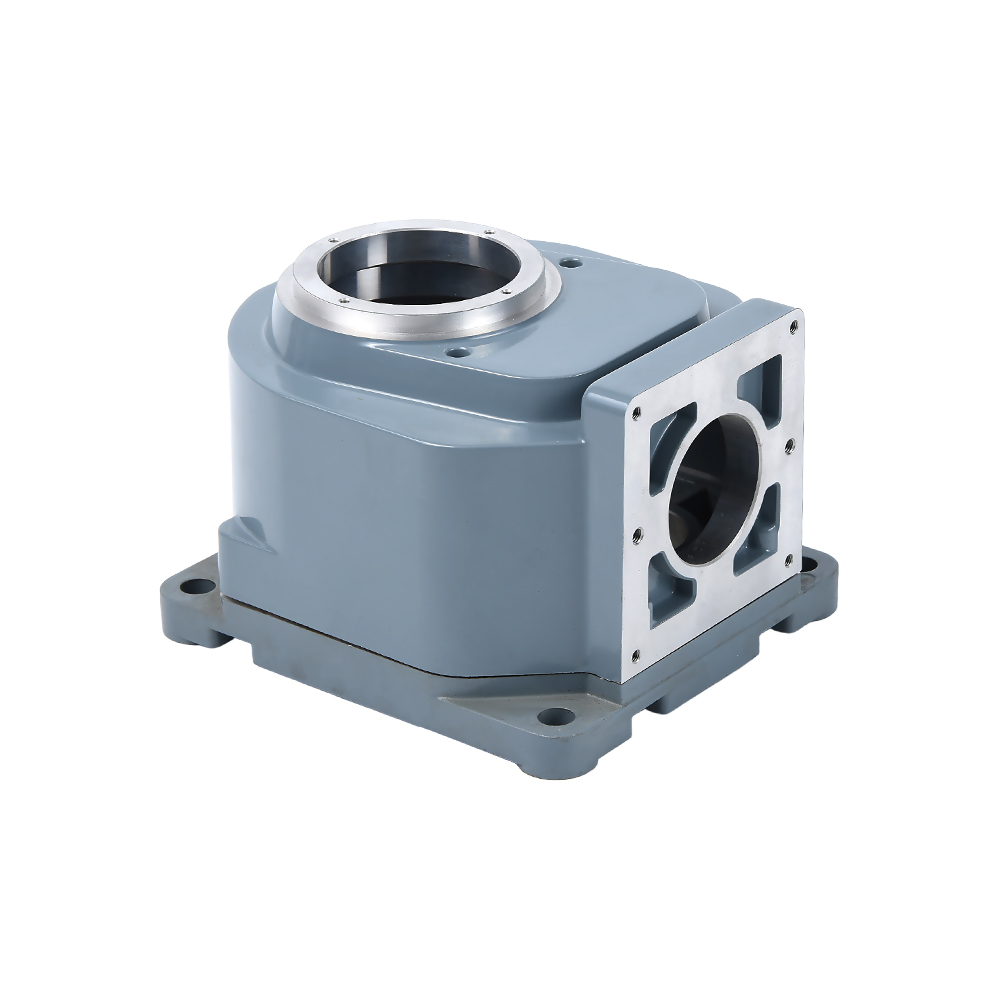
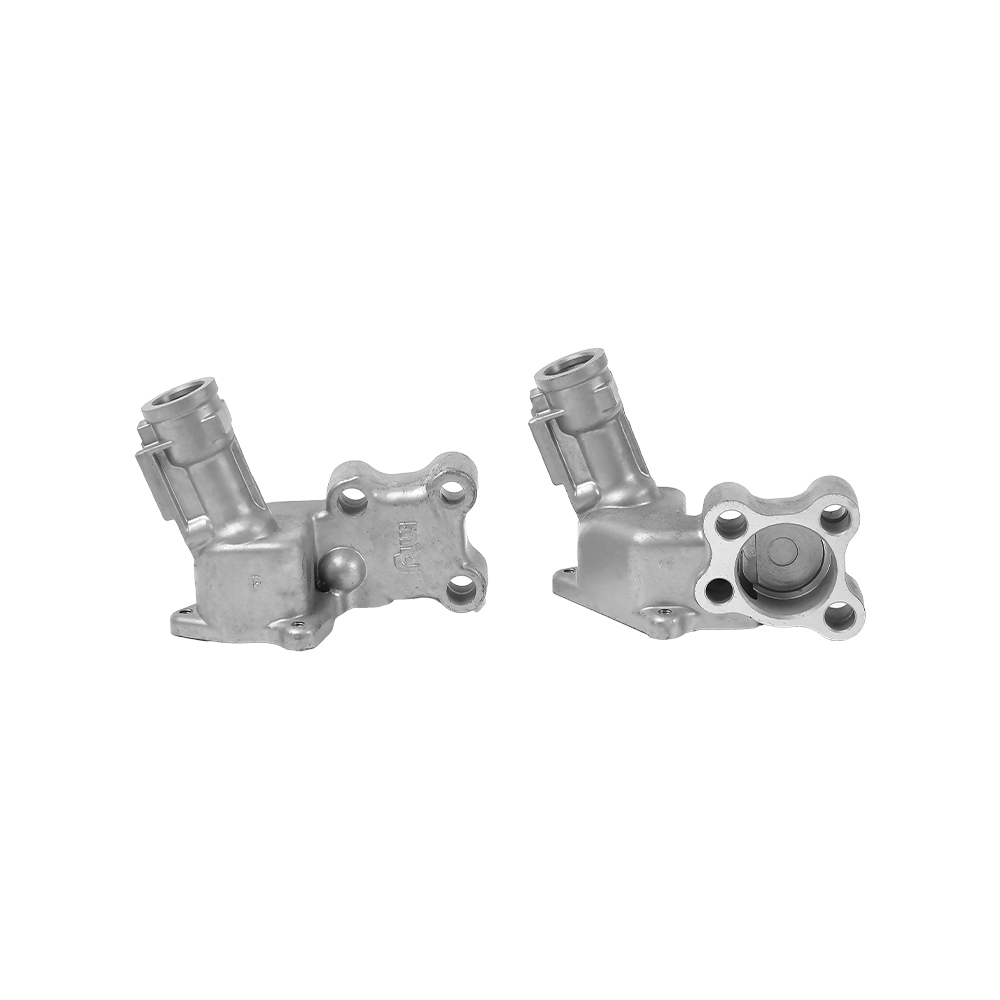
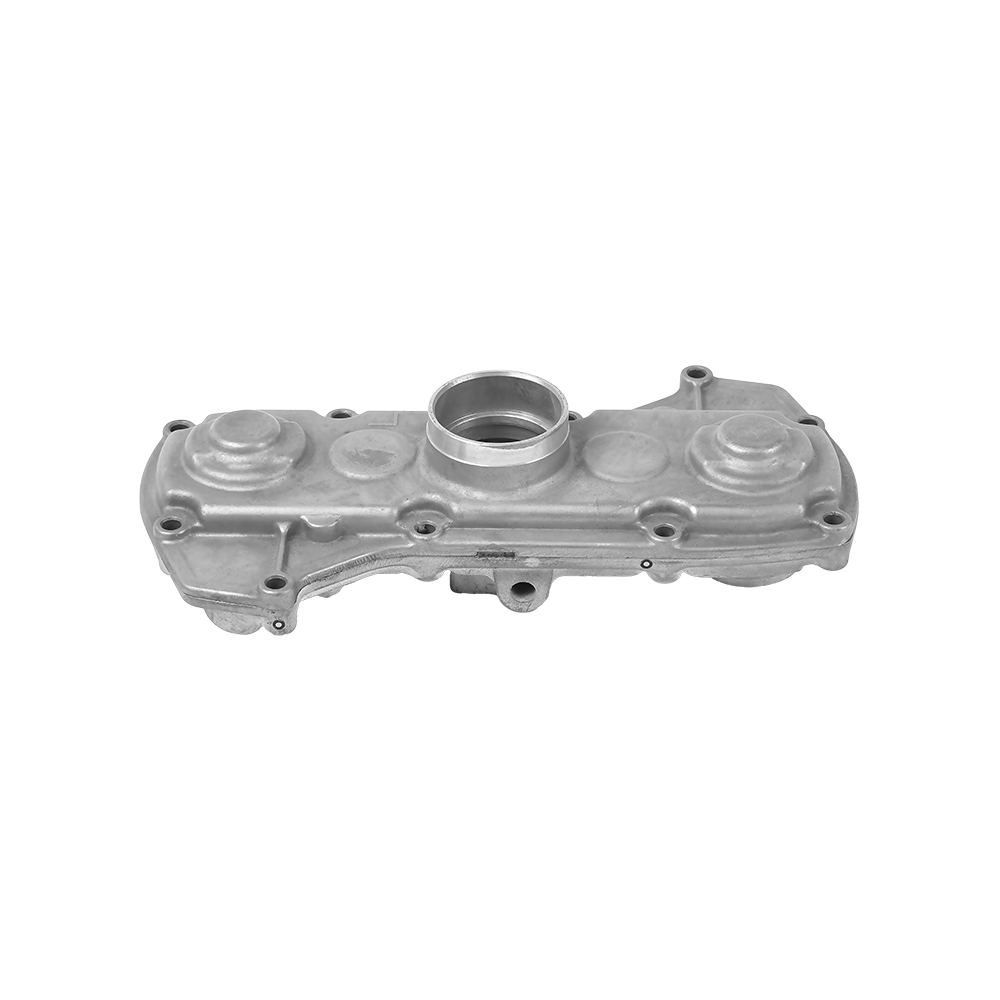
For automotive transmission housings, for example, the bore locations for bearing seats must be held within fractions of a millimeter. Die cast aluminum housings achieve this directly off the die, reducing machine time per part from what might be 20 minutes of CNC work down to 3–5 minutes of light finishing.
High Production Speed and Cycle Time
Speed is one of the defining strengths of the die casting process. Depending on part size and alloy, cycle times range from under 10 seconds for small zinc die cast components to 60–90 seconds for larger aluminum parts. A single die casting machine running a multi-cavity die can produce thousands of finished parts per shift.
Zinc die casting in particular is exceptionally fast. Small zinc components — connector housings, locking mechanisms, miniature structural parts — can be produced at rates exceeding 1,000 shots per hour on hot-chamber machines. This throughput is simply not achievable with investment casting, forging, or machining from bar stock.
High-pressure die casting (HPDC) lines in the automotive sector run nearly continuously, with automated part extraction, trimming, and quality inspection integrated directly into the cell. A well-optimized HPDC cell producing aluminum engine mounts or gear housings can output 400 to 600 complete parts per shift, with minimal operator intervention.
This speed advantage compounds over large production runs. When you need 500,000 identical parts per year, the per-unit cost of tooling amortizes rapidly, and the cycle time advantage translates directly into lower labor cost per part.
Complex Geometry Capability
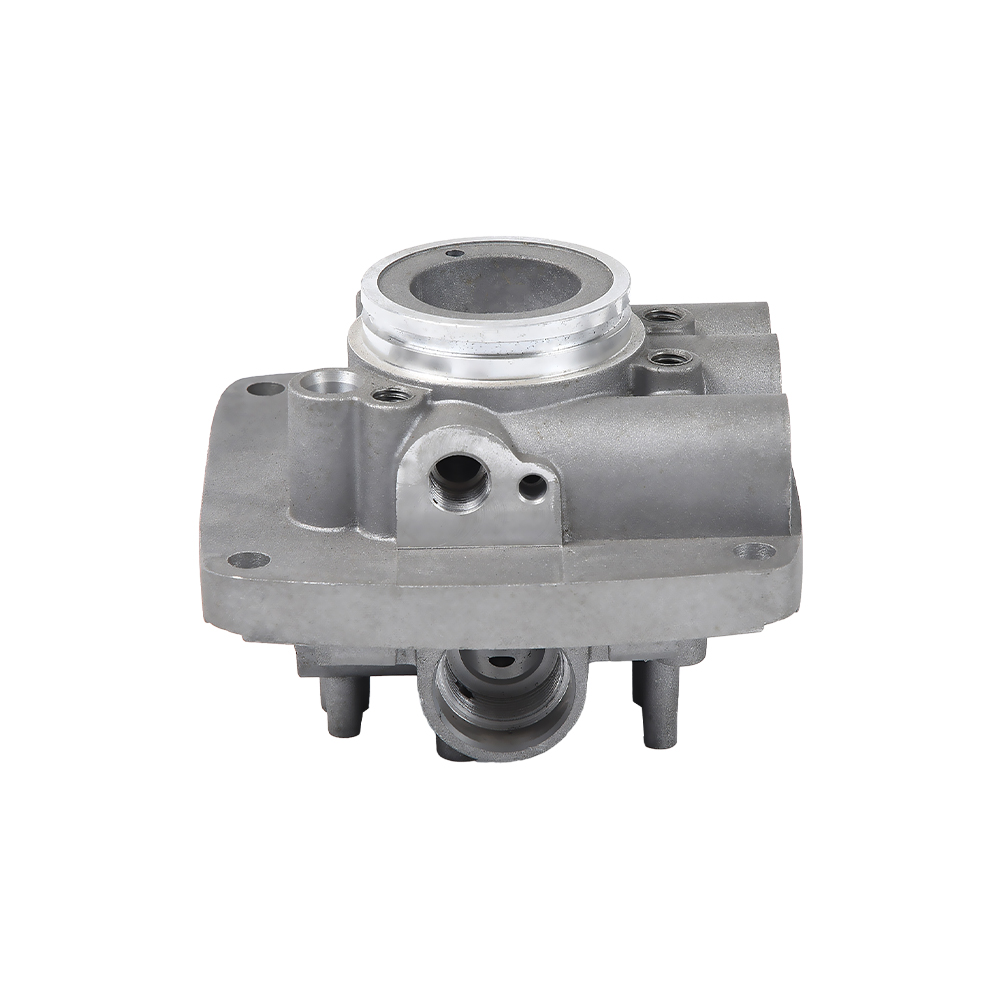
Die casting enables the production of parts with geometry complexity that would be prohibitively expensive using machining, and often impossible with forging. Internal passages, thin walls, complex external profiles, integrated mounting features, and decorative surface textures can all be incorporated into a single die cast part.
Thin Wall Capability
Aluminum die castings routinely achieve wall thicknesses of 1.5 to 2.5 mm. Zinc, which has superior fluidity, can produce walls as thin as 0.4 mm in small parts. This capability is critical for weight reduction in automotive and aerospace applications, and for size reduction in consumer electronics enclosures.
Part Consolidation
One of the most economically significant applications of die casting geometry capability is part consolidation — combining what were previously multiple fabricated and assembled components into a single die cast part. Tesla's use of large-format die casting (Giga Casting) consolidated over 70 individual stamped and welded parts in the rear underbody structure of the Model Y into a single aluminum die casting. This eliminated assembly fixtures, welding robots, and joining operations across a large portion of the body structure.
Similar logic applies at smaller scale across many industries. A die cast hydraulic manifold block can replace a machined block plus multiple welded fittings and ports, reducing both part count and potential leak points.
Surface Finish Quality
Die casting produces surface finishes in the range of Ra 0.8 to 3.2 µm directly from the die, without any additional machining or polishing. This is significantly smoother than sand casting (Ra 6.3–25 µm) and comparable to light machining operations.
The smooth as-cast surface is suitable for direct painting, powder coating, anodizing, or plating without extensive surface preparation. For consumer-facing products — handles, housings, decorative trim — this means lower finishing costs and faster time to a marketable appearance.
Die casting tooling can also incorporate textured surfaces, logos, part numbers, and fine detail directly in the die face, so branding and identification are cast in rather than applied as secondary operations.
Material Efficiency and Recyclability
Die casting is a near-net-shape process, meaning the volume of metal in the finished casting is close to the volume of metal consumed. Unlike machining from solid billet — where material removal rates of 50–80% are common for complex parts — die casting generates relatively little scrap. Runner systems, overflow wells, and flash are trimmed off and recycled directly back into the melting furnace.
The primary alloys used in die casting — aluminum, zinc, magnesium, and copper-based alloys — are all highly recyclable. Secondary aluminum alloys (produced from recycled scrap rather than primary smelted metal) account for the majority of aluminum used in die casting, and their production requires approximately 5% of the energy needed to produce primary aluminum from bauxite ore. This makes die casting an intrinsically more sustainable metal forming process compared to those relying on primary metal input.
In high-volume production, even small improvements in metal yield have significant cost implications. A facility casting 10,000 kg of aluminum per day that improves yield from 70% to 75% recovers 500 kg of saleable metal per day — a meaningful reduction in input cost and energy consumption.
Cost Economics at Scale
Die casting has high upfront tooling costs — a production die for a medium-complexity aluminum part typically costs between $50,000 and $250,000, depending on size, complexity, and number of cavities. For very large structural castings or multi-slide tooling, costs can exceed $500,000. This front-loaded investment is the primary barrier to die casting for low-volume applications.
However, once tooling cost is amortized across a sufficient production volume — typically 20,000 to 50,000 parts or more — the per-unit cost of die casting drops well below alternatives. The combination of fast cycle times, minimal labor per part, low scrap rates, and reduced secondary operations creates a unit economics profile that competing processes cannot match at volume.
| Process | Tooling Cost | Unit Cost at High Volume | Typical Tolerance | Surface Finish (Ra µm) |
|---|---|---|---|---|
| Die Casting | High ($50K–$500K+) | Low | ±0.05–0.1 mm | 0.8–3.2 |
| Sand Casting | Low ($500–$10K) | Medium–High | ±0.5–1.5 mm | 6.3–25 |
| Investment Casting | Medium ($5K–$50K) | High | ±0.1–0.3 mm | 1.6–3.2 |
| CNC Machining | Low–Medium | Very High | ±0.01–0.05 mm | 0.4–1.6 |
| Forging | High ($30K–$300K) | Medium | ±0.3–1.0 mm | 3.2–12.5 |
The table illustrates where die casting fits: it is not the cheapest option for low volumes, and it does not match CNC machining for ultimate precision. But for mid-to-high volume production of complex parts requiring good accuracy, smooth surfaces, and low per-unit cost, it occupies a position that no other process can fully replace.
Consistency and Repeatability Across Long Production Runs
A hardened H13 steel die used in aluminum die casting is typically rated for 100,000 to 200,000 shots before requiring refurbishment or replacement. Zinc casting dies, operating under lower temperatures and pressures, routinely exceed 1,000,000 shots. Throughout this service life, the die dimensions change minimally, meaning part dimensions remain within specification from the first shot to the last.
This repeatability is critical for assembly-line manufacturing. When thousands of identical parts must fit together with other components sourced from multiple suppliers, consistency is as important as accuracy. A die cast bracket that fits correctly at shot 1 should fit equally well at shot 100,000 — and in a well-maintained die casting operation, it will.
Modern die casting machines use closed-loop process control to maintain shot parameters — injection speed, pressure, die temperature, cooling time — within tight windows, further ensuring that part properties remain consistent across shifts, operators, and even facilities when the same die specification is used.
Alloy Options and Mechanical Properties
Die casting is not limited to a single material. The most commonly used die casting alloys each offer a specific performance profile:
- Aluminum alloys (A380, A383, ADC12): The most widely used die casting material. Good strength-to-weight ratio, excellent corrosion resistance, good thermal conductivity. Tensile strength typically 300–330 MPa. Ideal for automotive structural parts, electronics housings, pump bodies.
- Zinc alloys (Zamak 3, Zamak 5, ZA-8): Higher density than aluminum, but exceptional casting fluidity allows the thinnest walls and finest detail. Tensile strength 280–400 MPa. Used extensively in locks, hardware, connectors, and precision miniature parts.
- Magnesium alloys (AZ91D, AM60): Lightest structural metal used in die casting, approximately 35% lighter than aluminum. Tensile strength 230–260 MPa. Growing use in automotive instrument panels, steering columns, laptop chassis.
- Copper alloys (brass, bronze): Used where corrosion resistance, electrical conductivity, or bearing properties are required. Higher tooling wear due to elevated casting temperatures.
The mechanical properties of die cast parts, while generally lower than forged equivalents due to microporosity in the casting, are adequate for the vast majority of structural applications. Heat treatment of aluminum die castings (T5 or T6 temper) can further improve strength and hardness where needed, though this is limited to low-porosity parts produced by vacuum-assisted or squeeze die casting processes.
Applications Where Die Casting Delivers the Most Value
Understanding where die casting excels helps clarify when it should be specified over competing processes.
Automotive Industry
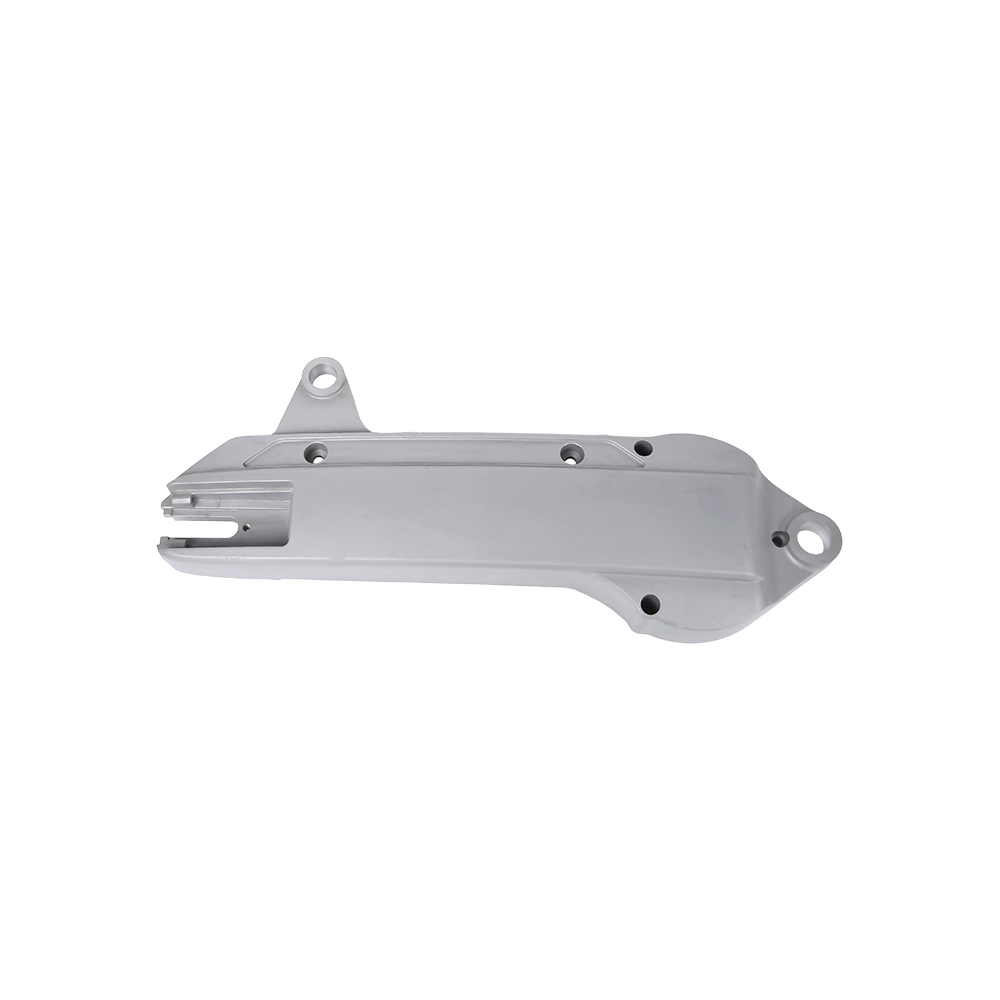
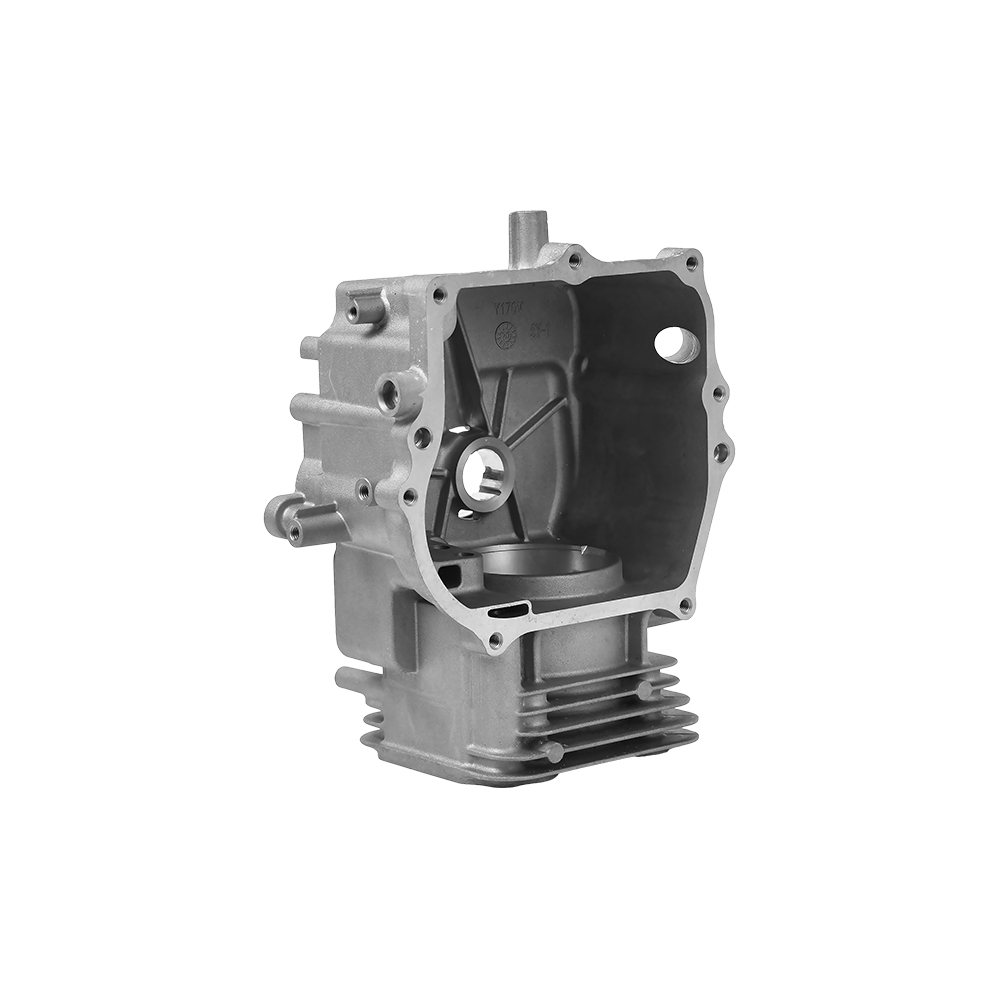
The automotive sector accounts for roughly 70% of all aluminum die casting production globally. Engine blocks, transmission cases, clutch housings, oil pumps, differential cases, suspension brackets, and EV battery housings are all commonly die cast. The drive toward vehicle lightweighting to improve fuel efficiency and EV range has accelerated the shift from iron and steel castings to aluminum die castings.
Consumer Electronics
Laptop frames, smartphone internal structural frames, camera bodies, and audio equipment housings are produced via die casting — primarily aluminum and magnesium. The ability to produce thin-wall structural frames with integrated heat dissipation features and mounting bosses makes die casting the preferred process for this sector.
Industrial Equipment and Power Tools
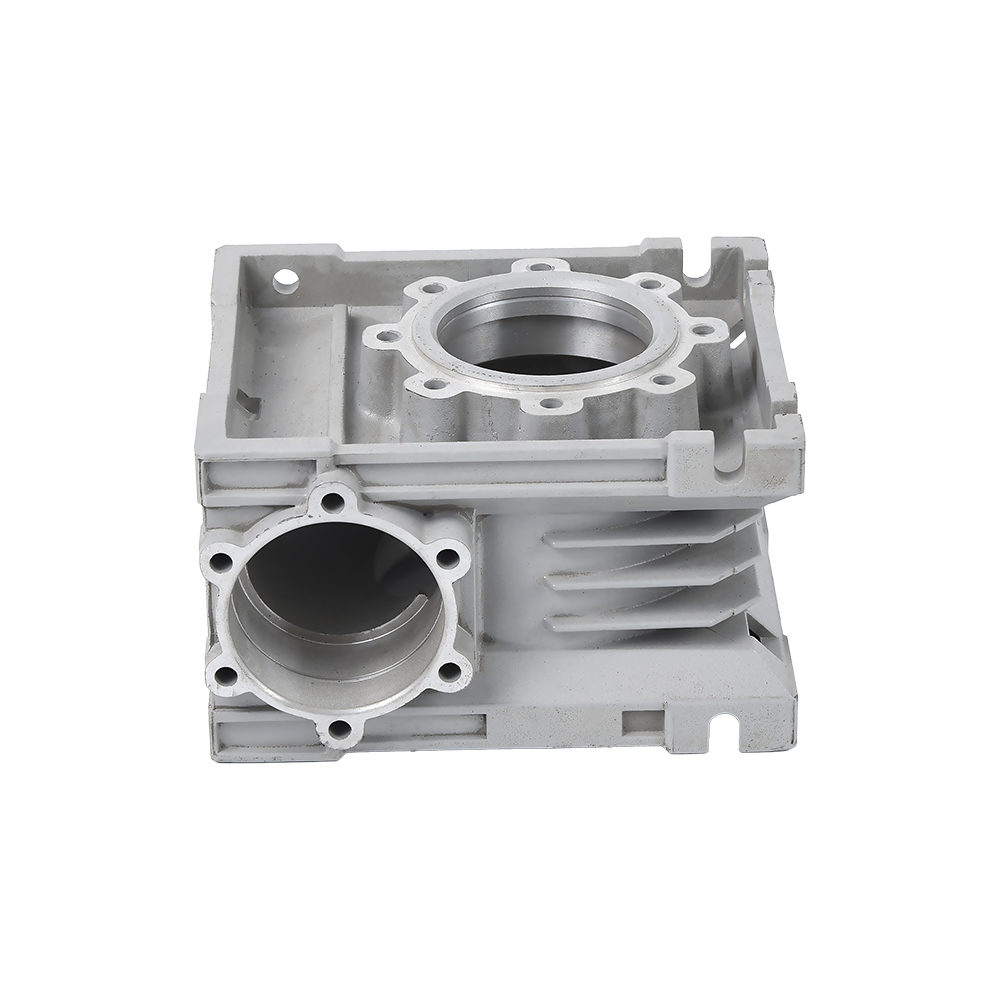
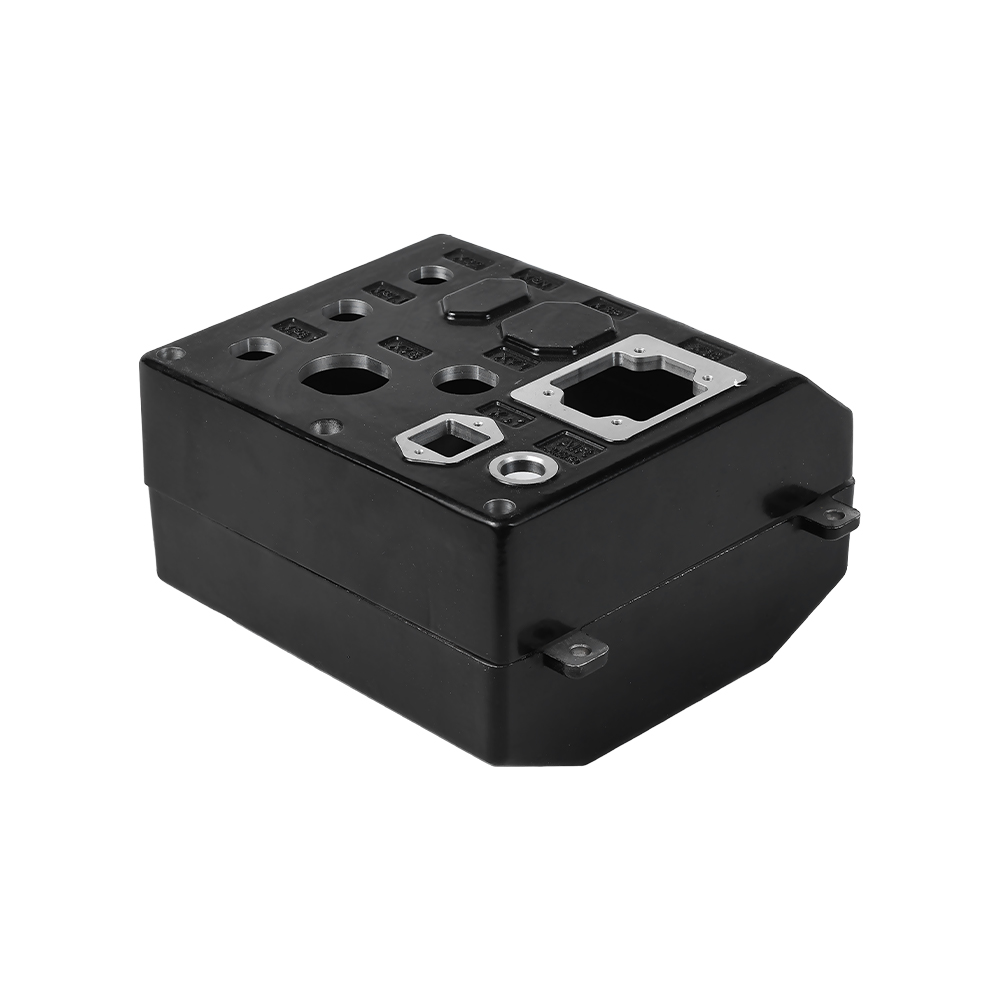
Gearbox housings, motor end caps, pneumatic and hydraulic valve bodies, and power tool housings are die cast at high volume for durability and dimensional precision. The ability to integrate complex internal porting into hydraulic valve bodies is a specific advantage of die casting over machined alternatives.
Hardware, Locks, and Fittings
Zinc die casting dominates the high-volume production of door hardware, padlock bodies, cabinet fittings, plumbing fixtures, and electrical connectors. The detail resolution and surface finish of zinc die casting match or exceed what is achievable by machining, at a fraction of the cost per unit at volume.
Limitations to Factor Into Your Process Selection
Die casting is not the right choice for every application. Being clear about its limitations prevents costly mistakes:
- High tooling investment: Low-volume production (under 10,000–20,000 parts) often cannot amortize tooling costs competitively. Sand casting or investment casting may be more economical at lower volumes.
- Porosity: Standard high-pressure die casting traps air in the casting, creating microporosity that limits weldability and makes heat treatment difficult. Vacuum die casting and squeeze casting mitigate this but add process cost.
- Limited alloy range: Not all metals are suitable for die casting. High-melting-point alloys like steel and titanium are not commercially die cast due to the extreme temperatures involved and rapid die wear.
- Part size constraints: Very large parts require very large and expensive machines. While structural die casting machines with clamping forces over 6,000 tons now exist, there are still practical limits on part size.
- Design constraints: Wall thickness must remain relatively uniform to avoid shrinkage defects. Deep undercuts and certain internal geometries require side actions or cores, adding tooling complexity and cost.
None of these limitations negate the core advantages of die casting — they simply define the operating envelope within which die casting is the optimal choice.
Emerging Developments Extending Die Casting Capability
The die casting process continues to evolve, expanding its range of applications and addressing historical limitations.
Vacuum-Assisted Die Casting
By evacuating air from the die cavity before injection, vacuum die casting dramatically reduces porosity. This enables T6 heat treatment of aluminum die castings, improving yield strength by 30–50% compared to as-cast condition and opening up structural applications previously limited to forgings.
Semi-Solid Die Casting (Rheocasting and Thixocasting)
Injecting metal in a semi-solid state — partially solidified into a slurry rather than fully liquid — reduces turbulence and trapped gas during injection. Semi-solid die castings have microstructures closer to forgings, with superior mechanical properties and weldability. Adoption is growing in automotive structural components.
Large-Format Structural Die Casting
Machines with clamping forces from 6,000 to 9,000 tons are being deployed for automotive structural mega-castings. These systems, pioneered in volume production by Tesla and now being adopted by multiple OEMs, produce body-in-white structures in single castings that previously required dozens of stamped and welded components. This represents a fundamental shift in how vehicle structures are manufactured.
Simulation-Driven Tooling Design
Advanced mold flow and solidification simulation software allows die casting tooling to be optimized before any metal is cut. Gate locations, runner geometry, overflow placement, and cooling channel design are validated digitally, reducing the number of tooling iterations required and shortening time from design to first production part. This reduces the historically high cost and timeline risk of die casting tooling development.